
A big ask--and a quick take
Help make film history, and read my thoughts on Maddie's Secret
Hey y’all—
First, an unabashed request for your help:
My partner Liz Purchell is at the forefront of indie film preservation, particularly with queer and trans art. There really is nobody else in the industry doing what she does through Muscle Distribution, either in terms of scope or scale, and I’m not just saying that as her partner of thirteen years. She’s now launched a fundraiser to restore and rerelease four underseen indie films. Every bit helps, and if you can’t give, I’d love it if you could pass it along to anyone interested in film or queer history. (And if you can do both, even better.) Thanks and thanks.
If you want to more easily share the Kickstarter, here is the link: https://www.kickstarter.com/projects/muscledistribution/help-muscle-restore-and-rerelease-four-underseen-indie-films
Your support will make huge things possible in independent and underground film history. Thank you.
Now, my quick take on Maddie’s Secret (2026). As always, read at your own risk of being mildly spoiled:
Maddie’s Secret (2026), dir. John Early, 98 mins.
There are certain terms I am no longer interested in using when describing film. Chief among them is “camp,” a word that I don’t think carries useful meaning for the reader anymore, a concept that now tells on its user the way “elevated horror” did several years prior. My disdain for the misuse of camp has taken on a “Crosseyed and Painless” tenor, a pipe bomb of grievances, the shrapnel hurtling towards people who stretch words into meaninglessness, queer people who have never turned down an opportunity to be confidently wrong, and heterosexual culture vultures who hang around the aforementioned homosexual ignorati. Camp had its own Met Gala: how could it mean anything anymore?
What I want to offer as a first premise is that there are registers of queer aesthetic and queer performance that do not glom onto the parameters of camp, however broad its territorial claim to affect. In other words, there has long been a place for sincerity that is neither caught unawares by the embarrassed spectator nor tarted up by the embarrassed performer. And I think it’s worth celebrating artists who tilt their cues towards those other pockets—artists who, say, lists Clockwatchers (1997) as their favorite film.
Maddie’s Secret is a quite good directorial debut by John Early that I also worry will be deemed a piece of camp or, more confusingly, a tribute to camp. Even if couched in glowing praise, I can’t accept those terms. It’s comedy that turns sincere rather than rolling its eyes at its own premise: an indie movie inspired heavily by “women’s issues” telefilms, with Early playing a cisgender lady unwinkingly. Rather than stumble into a self-amused posture, Maddie’s Secret takes the titular character’s inner torment seriously, as well as the emotional intelligence of its audience.
From a distance, Maddie Ralph suddenly seems to be living many millennials’ dream scenario. Thrust into internet stardom through a fluke cooking video, she has become a content darling, showcasing vegetarian cuisine at the very company where she had only recently been a mere dishwasher. She has a thick husband who is horny for her, a lesbian bestie who is also horny for her, and a public that can’t stop eating up her online tutorials. When a conniving coworker and an unscrupulous boss chip away at her fragile veneer of self-confidence, however, Maddie’s longstanding eating disorder resurfaces, kicking into overdrive when producers for a prestige television show about gritty high-end chefs come looking for behind-the-scenes talent to shape next season’s storylines. Maddie falls back into the perils of binging and purging, viscous and bilious and bloodshot, and any hope of recovery will require her to unravel decades of trauma—even if it means finally coming to terms with an unrepentant mother. How far will being seemingly perfect get you when you’ve already given yourself cardiac arrest?
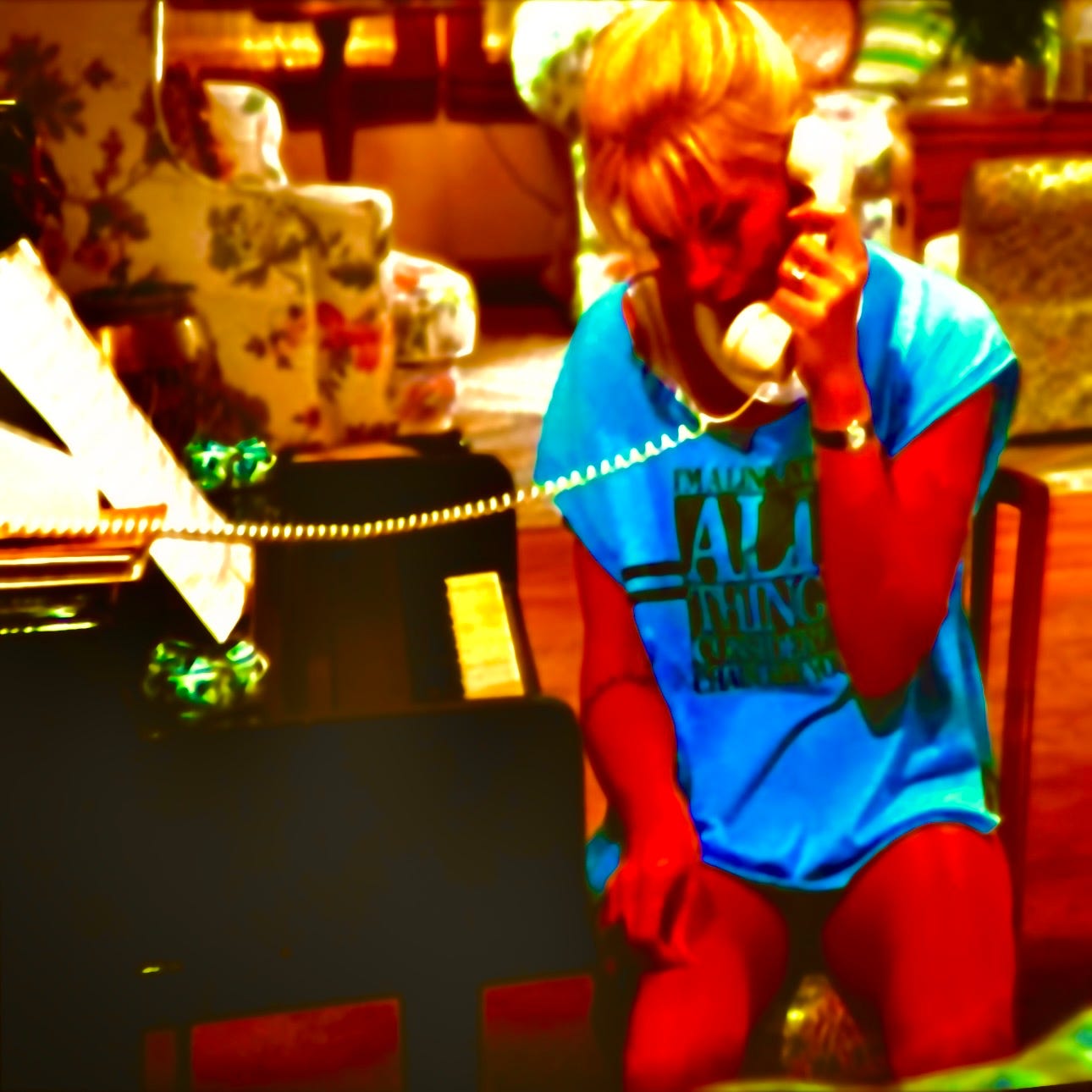
Early’s clearest inspiration for Maddie’s Secret is obviously the telefilm Kate’s Secret (1986), to the degree that I began openly commenting on the aligned plot points at several moments. (As an aside, casting Vanessa Bayer in the Tracy Nelson role is the exact right touch of inspired absurdity, particularly as both meet the same realistically grim fate.) This isn’t theft, or low-effort homage. Early’s recent interview with none other than Kate Secret’s star Meredith Baxter confirms that the source material is deeply respected and thoughtfully incorporated into a new story altogether. Forty years after Kate’s Secret, we’ve learned over and over and over that “having it all” is at best an exhausting shell game. Maddie isn’t a yuppie housewife but a woman working in digital content—vastly different economic realities. Maybe they’re both neoliberal subjects, but late capitalism makes the stakes vastly different. The attention economy gives Maddie a platform even as it strips all of us of our metadata. We’re not necessarily learning how to cook from people like Maddie: we’re forming parasocial bonds with digital personae, imagined hypertextual relationships that conveniently and purposefully add precious seconds to view times. Keep someone looking at the screen long enough with a catchphrase or self-effacing charm, and you can get them to like, subscribe, sit through extra ads, all the ultra-abstracted and nauseatingly conceptual ways we now experience the concept of revenue and the transfer of wealth. Even if she doesn’t have a TV, Maddie knows she’s subject to the whims of view rates—just as we, too, are aware of our cog-like role when we abide by the algorithm.
Amid broader economic shifts, the contexts for eating disorders have also developed new dimensions since the 1980s. (Please don’t mistake this for vulgar armchair marxian analysis; it’s merely to say that a) disorder and disability always have sociohistorical contexts and b) foundational economic changes will beget new sociohistorical contexts.) As one patient at the rehab facility quips when stripping away Maddie’s false self-assurance, we live in an era of easy Ozempic and cheap plastic surgery. If Maddie truly wanted to just be thin, she could find a way to do so without tipping into bankruptcy. As millennials lurch towards middle age, the once-heralded savior generation now blamed for their own inability to retire, the urge to white-knuckle another shitty year until things settle down is hard to shake. Bulimia has always been about more than the need to be thin, but when the price point for conjuring a new body is lower than ever, the disorder also offers the extra allure of losing control, to bliss out by forgetting about the very thing that created inner torment the rest of the day.
Without turning this into the dreaded millennial cliche of memoir masquerading as other nonfiction, I know this mental circuit all too well. Like Maddie, I had an eating disorder—the same one, in fact—which I kept at bay until it returned, voices in my head nastier than they had ever been before. Like Maddie, I’ve also had compliments about how healthy or refreshing I look contort in my mind until I punished myself by whatever means necessary. And like Maddie, I found the black-out patches of binging and purging to be a genuine relief, the one moment my mind could shut up about whether I needed to hurt myself like this or when the persistence was going to wreck my teeth or heart beyond repair. An easy GLP-1 prescription or a few nips and tucks really won’t shake away the core issues; otherwise I would’ve said yes to both as early as possible.
Early uses the final scenes to tether his film back into dramatic territory. Maddie doesn’t chew out her nemesis when they interact one final time, nor does her enemy suddenly become a new woman. People change by degrees, and while Emily is chastened by the fallout from her affair with their old boss, she is no less arrogant when assessing her own skills against her former coworker’s—after all, she’s the one who landed the gig with The Boar. But, as that final exchange makes clear, if bitchily feigned nonchalance remains a go-to millennial coping mechanism, so is performative humility. Maybe Gone Girl and its many spiritual successors made the Cool Girl archetype a known crutch, but the women who repeatedly “stays in her own lane,” whose glances and expressions transmit modesty, who can only attribute their success to luck and circumstance rather than ambition or savvy, are also hiding behind an approved script for women. They’re both types of self-erasure, whether or not they’re attached to a screwy relationship to food. Most impressively, the final scene mirrors the first, leaving us with the sense that Maddie is now a different person from when we first saw her running ninety minutes earlier, while also making clear that her closest relationships have been forever changed. Wherever she’s running, she’s running alone.
When I first became aware of Early the better part of a decade ago, I mentally lumped him in with several other young handsome blond white guys who worked in comedy, less clones and more an imagined clique, all competing for their own spot in the nascent attention economy. While most of those other young handsome blond white guys are still in comedy, some doing interesting work, it’s been Early who has shown himself as an unmistakeable talent, able to take on filmmaking with as much skill as he has Broadway and music-heavy standup specials. Maddie’s Secret has a few false steps, but they’re easy to spot even for a casual viewer and, more importantly, don’t take away from our ability to root for Maddie or Early. As another tall blond food maven and daydream peddler would say, “It’s a good thing.”
4/5 — and a hard recommendation to see it in theaters rather than wait for streaming if you have the chance.
Thanks again, and thanks for giving to Muscle Distribution’s Kickstarter. I’ll be waiting on the line for your call. Until next time—KJ